

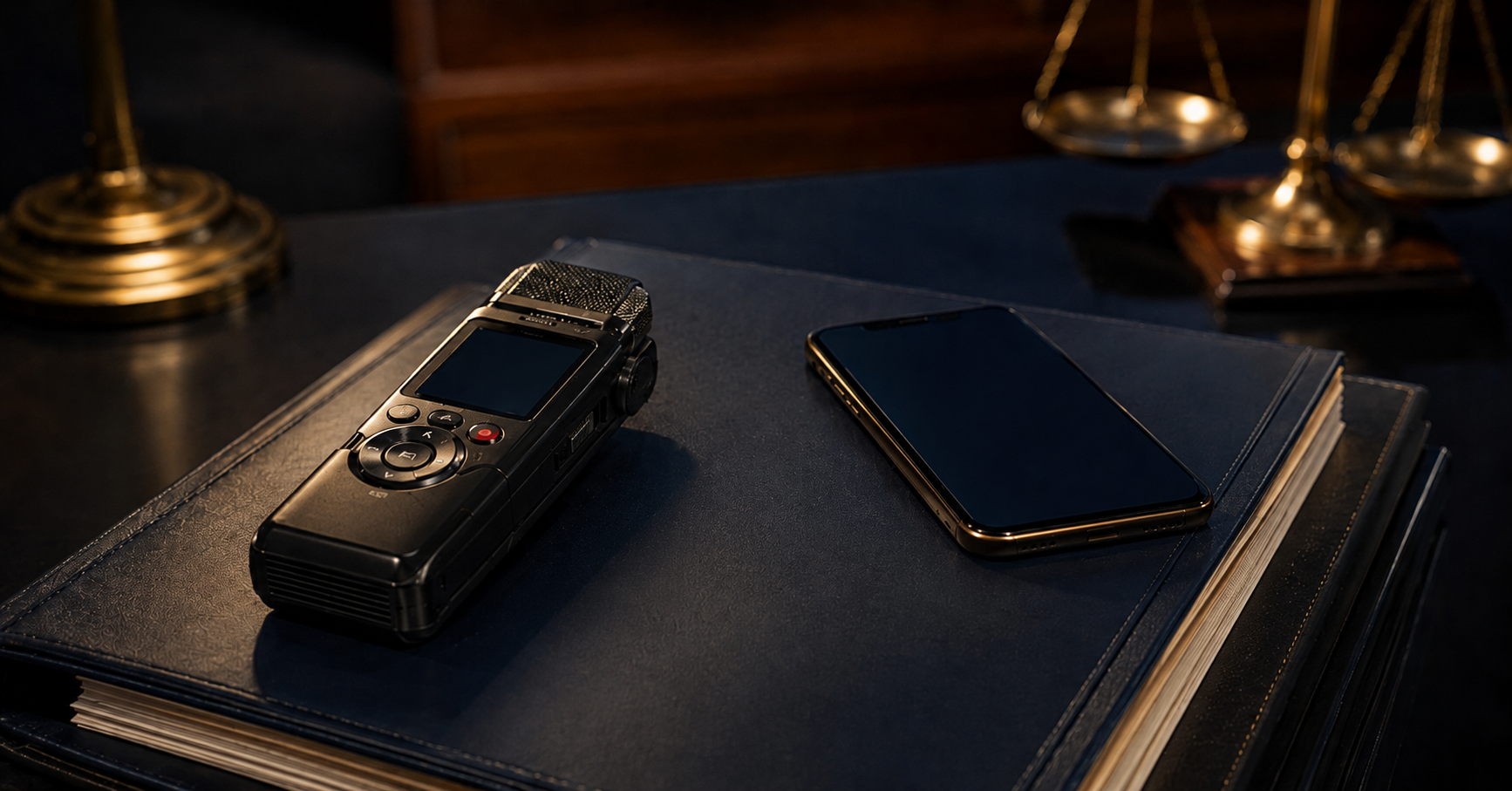
Audio and Video Recordings as Evidence in Trinidad and Tobago Courts
Yes — a secretly recorded phone call or video can be used as evidence in a Trinidad and Tobago court, provided it satisfies the admissibility conditions set out in the Evidence Act, Chapter 7:02 of the Laws of Trinidad and Tobago. Whether you made the recording yourself, retrieved it from a CCTV system, or downloaded a WhatsApp message, the fundamental question for the court is not only whether the recording was lawfully obtained, but whether it is authentic, reliable, and more probative than prejudicial. In criminal proceedings, the Audio Visual Recordings Rules 2010 (Legal Notice No. 108 of 2010), made under the Evidence Act, impose additional formal requirements on recordings made by the police or the State before those recordings can be tendered in evidence.
What Counts as a "Recording" Under Trinidad and Tobago Law?
The Evidence Act, Chapter 7:02 gives the word "document" a deliberately broad definition that extends well beyond paper. Under the Act, a document includes any disc, tape, sound track, or other device on which sounds or other data are recorded so as to be capable of being reproduced. A video file, a voice note, a CCTV recording, a dashcam clip, and a WhatsApp audio message all fall within this definition.
Under the Evidence Act, Chapter 7:02 of the Laws of Trinidad and Tobago, a recording — whether audio, video, or audio-visual — is treated as a "document" and may be admitted as documentary evidence under Section 44 of the Act, provided the party seeking to rely on it can prove its authenticity and chain of custody.
This broad statutory definition means that the admissibility rules that govern written documents — including the requirement to produce the original or a certified copy, and to prove that the document has not been altered — apply equally to recordings. A party who tenders a recording without being able to verify its authenticity risks having it excluded.
Section 44 and Section 52: The Two Main Gateways
Two provisions of the Evidence Act are particularly relevant to recordings:
Section 44 — Documentary Evidence: This section governs the admission of documents (in the broad statutory sense described above) in civil and criminal proceedings. A recording tendered under Section 44 must be accompanied by evidence establishing that it is what it purports to be — a genuine, unaltered record of the event or conversation it depicts.
Section 52 — Hearsay Exceptions: Section 52 provides a gateway for admitting statements made by a person in circumstances where that person is not called as a witness, or where the recording is used to prove what was said or done at a particular time. A recording of a conversation may be admitted not merely as a document, but as evidence of the truth of what was said — provided the court is satisfied that the circumstances in which the recording was made give the statement sufficient reliability.
Together, these two sections mean that a recording can serve two distinct evidential purposes: it can prove that certain words were spoken (a documentary function), and in appropriate cases it can prove the truth of those words (a hearsay function).
The Audio Visual Recordings Rules 2010: State and Police Recordings
When the police or a State agency makes a recording — for example, a recorded interview under caution, a surveillance recording, or footage from a police body-worn camera — the Audio Visual Recordings Rules 2010 (Legal Notice No. 108 of 2010) govern the conditions under which that recording can be tendered in evidence in a criminal court.
Under the Audio Visual Recordings Rules 2010, a recording made by the police or the State is only admissible in criminal proceedings in Trinidad and Tobago if it is accompanied by a certificate from the person who made the recording, setting out the date and time of the recording, the equipment used, and confirmation that the recording has not been altered.
The Rules require:
- Authentication by certificate — the person who made the recording must provide a signed certificate confirming their identity, the equipment used, and the circumstances in which the recording was made.
- Equipment details — the certificate must identify the recording device, including make, model, and — where relevant — calibration records.
- Chain of custody — there must be a clear, documented account of who had possession of the recording from the moment it was made to the moment it was tendered in court. Any gap in the chain of custody is a ground for challenging admissibility.
These requirements reflect the courts' concern that digital recordings are, in principle, susceptible to editing or fabrication. Compliance with the Rules creates a rebuttable presumption that the recording is authentic; non-compliance does not automatically exclude the recording but gives opposing counsel a strong basis for objection.
Legality of Making the Recording vs. Admissibility as Evidence
One of the most common sources of confusion is the distinction between whether it was lawful to make a recording and whether that recording can be used in court. These are separate questions, and the answer to one does not automatically determine the answer to the other.
Making the recording: In Trinidad and Tobago, there is no general statute that makes it a criminal offence for a private individual to record a conversation to which they are a party. A person who records their own telephone call — even without telling the other party — does not thereby commit an offence under the laws of Trinidad and Tobago as of April 2026. However, the Interception of Communications Act, Chapter 15:10 of the Laws of Trinidad and Tobago prohibits the interception of telecommunications by a third party who is not a party to the communication. Under Chapter 15:10, if you intercept someone else's call without their consent and without a warrant, you are committing a criminal offence — regardless of what you do with the recording afterwards.
Covert interception by police: Under the Interception of Communications Act, Chapter 15:10, the police may intercept telecommunications (including phone calls) only with a warrant issued by the President of Trinidad and Tobago. There is no T&T equivalent of the United Kingdom's Regulation of Investigatory Powers Act (RIPA); the Presidential warrant requirement under Chapter 15:10 is the primary safeguard against unlawful State surveillance of private communications.
Admissibility despite unlawful obtaining: The fact that a recording was unlawfully obtained does not automatically render it inadmissible. Trinidad and Tobago courts — following the common law approach applied in the Privy Council and English courts — retain a discretion to admit evidence even if it was obtained in breach of a person's rights, weighing the probative value of the evidence against the prejudice to the accused and the public interest in maintaining the integrity of the justice system. However, a recording obtained in deliberate breach of a person's constitutional rights — for example, by an unlawful State interception without a Presidential warrant — is more likely to be excluded than one recorded by a private party in a civil dispute.
Authentication: The Core Requirement
Whether a recording is made by the police, a business, or a private individual, authentication is the threshold requirement for admissibility. The court must be satisfied — at minimum — on the following points:
| Authentication Question | What the Court Needs |
|---|---|
| Who made the recording? | Evidence from the person who operated the device, or a certificate where the Rules apply |
| When was it made? | Date and time metadata, or testimony from the recorder |
| What device was used? | Make, model, and condition of the recording device |
| Has it been altered? | Chain of custody evidence; expert evidence if tampering is alleged |
| Is it what it purports to be? | Corroborating evidence — e.g., transcripts, witness testimony about the conversation |
Where the opposing party challenges authenticity, the court may require expert evidence from a digital forensics specialist. This is particularly relevant where a recording has been transmitted across multiple platforms (for example, a voice note forwarded several times on WhatsApp) and the original metadata may have been lost or modified.
Types of Recording: Admissibility at a Glance
| Type of Recording | Who Made It | Key Admissibility Conditions |
|---|---|---|
| Police interview (audio/video) | Police / State | Audio Visual Recordings Rules 2010: certificate, equipment details, chain of custody |
| CCTV footage (commercial premises) | Business owner | Authentication by person responsible for the system; chain of custody |
| Dashcam footage | Private individual | Authentication by vehicle owner; continuity of recording |
| Private phone recording (party to call) | Private individual | Authentication; no offence under T&T law for a party to record their own call |
| Covert interception (non-party) | Third party | Potentially unlawful under Ch. 15:10; admissibility at court's discretion |
| WhatsApp messages / voice notes | Private individual | Section 44 Evidence Act; original metadata may be required |
| Social media video | Private individual | Section 44; screenshots admissible as documentary evidence; metadata preferred |
| AI-generated / deepfake content | — | No specific T&T law as of April 2026; general authentication principles apply; expert evidence strongly advisable |
Criminal vs. Civil Proceedings: Different Standards
In criminal proceedings, recordings face a higher level of scrutiny. The court must be satisfied beyond reasonable doubt of the facts to be proved, and the probative value of the recording must outweigh its prejudicial effect on the accused. The Judge's Rules — a body of rules of practice for criminal proceedings, applied in T&T following the English common law tradition — require that caution statements and recorded interviews be made under conditions that guarantee voluntariness and freedom from oppression. A recording of an interview that was not conducted in compliance with the Judge's Rules may be excluded even if it is technically authentic.
In criminal proceedings in Trinidad and Tobago, a court has an overriding discretion to exclude any evidence — including an authenticated recording — if its prejudicial effect on the accused substantially outweighs its probative value, following the approach consistently applied in courts of the Commonwealth Caribbean.
In civil proceedings, the admissibility threshold is lower. Evidence is generally admissible if it is relevant to the issues in dispute, and the court has a discretion to exclude it if it was obtained by means that make its admission unfair. A recording that was secretly made by one party to a civil dispute — for example, a recording of a conversation with a landlord or employer — is routinely admitted in civil courts in Trinidad and Tobago, provided it can be authenticated.
Specific Recording Types: Practical Guidance
CCTV Footage
CCTV recordings from commercial premises — shops, banks, offices, petrol stations — are among the most commonly tendered recordings in both criminal and civil proceedings in Trinidad and Tobago. The business owner, or the person responsible for maintaining the system, must be able to give evidence that:
- the system was operational at the relevant time;
- the recording is a genuine, unaltered extract from the system's archive;
- the clock on the system was accurate; and
- the recording has been preserved without modification.
Where a business has outsourced its CCTV management to a third-party provider, the chain of custody becomes more complex. The court will generally require evidence from the person who extracted the footage, not merely the person who owns the premises.
WhatsApp and Social Media Evidence
Printouts and screenshots of WhatsApp conversations, Facebook messages, and other social media content are admissible as documentary evidence under Section 44 of the Evidence Act, Chapter 7:02. However, a screenshot alone — without underlying metadata — may be challenged on the basis that it could have been edited. Best practice is to preserve the original device, export the conversation in its native format (which retains metadata), and be prepared to give oral evidence about the circumstances in which the messages were sent and received.
Under Section 44 of the Evidence Act, Chapter 7:02, a printed screenshot or exported record of a WhatsApp conversation is admissible as a document in Trinidad and Tobago court proceedings, but the court retains a discretion to require production of the original metadata where the authenticity of the record is in dispute.
Voice Recognition Evidence
Where the identity of a speaker on a recording is disputed, Trinidad and Tobago courts may receive expert evidence on voice recognition. The Privy Council case of R v Robb [1991] 93 Cr App R 161 (English Court of Appeal, persuasive in Trinidad and Tobago) established that evidence of voice identification by a suitably qualified expert is admissible — even without scientific instrumentation — where the expert has an adequate basis for the opinion. The weight to be given to voice recognition evidence is a matter for the tribunal of fact.
Deepfakes and AI-Generated Content
As of April 2026, Trinidad and Tobago has no specific legislation addressing AI-generated audio or video content. The general authentication principles under the Evidence Act apply: the party tendering the recording must prove it is what it purports to be. Where deepfake manipulation is alleged, the court is likely to require expert evidence from a qualified digital forensics specialist. This is a rapidly developing area, and readers should obtain current legal advice if this issue arises in their matter.
What the Law Says in Trinidad and Tobago
| Statute / Instrument | Relevance |
|---|---|
| Evidence Act, Chapter 7:02 | Primary statute governing admissibility of documents (including recordings) in T&T civil and criminal proceedings; Sections 44 and 52 are the key gateways |
| Audio Visual Recordings Rules 2010 (Legal Notice No. 108 of 2010) | Sets out conditions for admissibility of recordings made by the police or State; requires certificate, equipment details, and chain of custody |
| Interception of Communications Act, Chapter 15:10 | Prohibits interception of telecommunications by non-parties without consent; police interceptions require a Presidential warrant |
Frequently Asked Questions
Can a secretly recorded phone call be used as evidence in a Trinidad and Tobago court?
Yes, a secretly recorded phone call can be tendered as evidence in a Trinidad and Tobago court, provided it can be authenticated. Under the Evidence Act, Chapter 7:02, a recording is treated as a document and is admissible if it is genuine, unaltered, and relevant to the proceedings. The fact that the other party to the conversation did not know they were being recorded does not, by itself, make the recording inadmissible — nor does it constitute a criminal offence under T&T law where the person recording was a party to that conversation. The court will, however, exercise a discretion to exclude the recording if its admission would be unfair or if its prejudicial effect outweighs its probative value, particularly in criminal proceedings.
Is it a crime to record someone without their knowledge in Trinidad and Tobago?
It depends on who you are in relation to the conversation. In Trinidad and Tobago, there is no general criminal statute prohibiting a party to a conversation from recording it without telling the other party. If you are speaking to someone — in person, on the phone, or on a video call — and you record that conversation yourself, you are not committing an offence under T&T law as of April 2026. However, if you are a third party intercepting a call between two other people without their knowledge and without lawful authority, you may be committing an offence under the Interception of Communications Act, Chapter 15:10. The distinction is between recording your own conversation and intercepting someone else's.
Do police need a warrant to record my phone calls in Trinidad and Tobago?
Yes. Under the Interception of Communications Act, Chapter 15:10 of the Laws of Trinidad and Tobago, the police cannot lawfully intercept telecommunications — including phone calls, text messages, and data transmissions — without a warrant. That warrant must be issued by the President of Trinidad and Tobago, not by a judge or magistrate. This is a higher threshold than in many other jurisdictions. Evidence obtained by the police through an unlawful interception — made without a Presidential warrant — is liable to be excluded from criminal proceedings, and the officers responsible may face criminal liability under Chapter 15:10.
Can CCTV footage from a shop or office be used in court?
Yes. CCTV footage from commercial premises is regularly admitted as evidence in both criminal and civil proceedings in Trinidad and Tobago. The business owner or the person responsible for the CCTV system must be able to authenticate the recording — confirming that the system was operational, the clock was accurate, the footage has not been edited, and the chain of custody from the system to the court has been maintained. Where a recording has been stored on a cloud platform or managed by a third-party contractor, additional evidence from those parties may be required. Failure to preserve original CCTV footage promptly — for example by recording over it — can itself become an issue in litigation.
Are WhatsApp messages and voice notes admissible as evidence?
Yes. WhatsApp messages, voice notes, and screenshots of social media conversations are admissible as documentary evidence under Section 44 of the Evidence Act, Chapter 7:02. A printout or screenshot is sufficient in most cases to begin — but where the opposing party challenges the authenticity of the record, the court may require production of the original device and the underlying metadata. Voice notes forwarded many times across WhatsApp may have degraded metadata; best practice is to preserve the original device on which the voice note was first received, or to use a certified export of the conversation. Courts in Trinidad and Tobago have admitted WhatsApp evidence in family, civil, and criminal matters, applying the standard documentary evidence rules.
What happens if an audio recording has been edited or tampered with?
If there is reason to believe that a recording has been edited or tampered with, the court may order that it be examined by a qualified digital forensics expert before any decision is made on admissibility. Under the general law, a party who tenders a recording that has been materially altered without disclosure commits a serious abuse of process. In criminal proceedings, a recording that is shown to have been tampered with will almost certainly be excluded, and the person responsible may face consequences for attempting to pervert the course of justice. In civil proceedings, the court has a broad discretion to exclude tampered evidence and to draw adverse inferences against the party who tendered it. Chain of custody documentation — showing who had access to the recording from the moment it was made — is the primary safeguard against tampering allegations.
Can a deepfake video be used to frame someone in court, and is there a law against it in Trinidad and Tobago?
As of April 2026, Trinidad and Tobago has no specific legislation criminalising the creation or use of deepfake audio or video content. However, a person who tenders a deepfake recording in court proceedings — knowing it to be fabricated — would be committing perjury and perverting the course of justice under existing law. On the admissibility side, any party who suspects that a recording tendered against them is AI-generated or manipulated should apply to the court for an order requiring expert forensic examination of the recording before it is admitted. The general authentication requirements under the Evidence Act, Chapter 7:02 apply: the party tendering the recording must prove it is what it purports to be, and a sufficiently qualified expert can give evidence that a recording shows signs of AI manipulation. This area of law is developing rapidly; readers should obtain specialist legal and technical advice if this issue arises.
Can a recording made on a dashcam be used as evidence in a road accident claim?
Yes. Dashcam footage is increasingly tendered in road accident claims and criminal prosecutions for driving offences in Trinidad and Tobago. The same authentication principles apply: the vehicle owner or driver must be able to give evidence that the dashcam was functioning correctly at the relevant time, that the date and time settings were accurate, and that the footage has not been edited between the time of the incident and the time it is tendered in court. Dashcam footage that shows the aftermath of a collision — or footage from a nearby business's CCTV — may also be subpoenaed by either party in civil litigation. Preserving the original footage promptly, before it is overwritten by the device's loop recording function, is critical.
Written by Martin George, Attorney-at-Law. Martin George is the founder and principal attorney of Martin George & Company, with more than 35 years of active legal practice in the courts of Trinidad and Tobago. He is a former Commissioner on the Law Reform Commission of Trinidad and Tobago and a member of the Prime Minister's Constitutional Committee for Internal Self-Government for Tobago. This article is published for general information and public legal education. It does not constitute legal advice. For advice on your specific situation, contact Martin George & Company.
Last reviewed: April 2026