
State of Public Emergency in Trinidad and Tobago
Under the law of Trinidad and Tobago, a State of Public Emergency (SOE) lets the President, on Cabinet's advice, suspend ordinary civil liberties and authorise extraordinary policing powers. It is governed by sections 7 to 11 of the Constitution of the Republic of Trinidad and Tobago, Chapter 1:01. An SOE lasts an initial 15 days; further extensions beyond an early six-month aggregate require a three-fifths supermajority of each House.
What is a State of Public Emergency?
A State of Public Emergency is a temporary constitutional condition that permits the State to take action which would otherwise breach the fundamental rights guaranteed by sections 4 and 5 of the Constitution. Those derogations are not unlimited. Section 11 of the Constitution preserves independent tribunal review of detentions, and section 7(3) requires that emergency regulations be "reasonably justifiable" for dealing with the emergency.
The SOE regime is exceptional, not routine. It is triggered only by one of the grounds listed in section 9, and every SOE is subject to parliamentary oversight under sections 9 and 10. In practice, SOEs in Trinidad and Tobago have been declared in response to political insurrection, gang violence, public health crises and natural disasters.
Who Has the Power to Declare a State of Emergency in Trinidad and Tobago?
The President of the Republic alone has the legal power to issue a Proclamation of public emergency under section 8. However, by the constitutional rule codified in section 80 of the Constitution, the President exercises this power on the advice of Cabinet, communicated through the Prime Minister. The Proclamation is then published in the Trinidad and Tobago Gazette and takes immediate effect.
The Cabinet's advice is not formally reviewable, but the Proclamation itself and any regulations made under it are subject to judicial review on conventional administrative-law grounds, including illegality, irrationality and breach of fundamental rights.
In modern practice, the Prime Minister announces the SOE publicly, often in concert with the Minister of National Security and the Attorney General, who explain the operational scope of the Emergency Powers Regulations issued under section 7.
What Are the Constitutional Grounds for Declaring an SOE?
A Proclamation under section 8 is invalid unless, as required by section 9, it states that the President is satisfied that a public emergency has arisen for one of the specified reasons. The grounds are exhaustive — they cannot be expanded by ordinary legislation.
The four constitutional grounds are:
- Imminence of war between Trinidad and Tobago and a foreign State.
- Natural disaster or calamity — earthquake, hurricane, flood, fire, outbreak of pestilence or infectious disease.
- Action endangering public safety — including action likely to deprive the community of supplies or services essential to life.
- Action taken to overthrow the Government by unlawful means.
In practice, the second ground supported the COVID-19 SOE in 2021 and the third ground supported the 2011 and 2024 anti-crime declarations. The 1990 Proclamation rested on the fourth ground after the Jamaat al Muslimeen attack on the Red House — see the Report of the Commission of Enquiry into the 1990 Attempted Coup.
How Long Does a State of Emergency Last?
The duration of an SOE is controlled by sections 9 and 10 of the Constitution. Under section 9, the initial Proclamation lapses automatically after 15 days unless Parliament intervenes. From there, section 10 caps every extension.
The parliamentary controls operate as follows:
- Under section 9, the President must deliver a statement of grounds to the Speaker within 3 days of the Proclamation, and a debate must be held in the House of Representatives not later than 15 days after the Proclamation.
- Under section 10(1), the Proclamation may be extended by a resolution of the House of Representatives supported by a simple majority, but no single extension may exceed 3 months and the aggregate of such simple-majority extensions may not exceed 6 months.
- Under section 10(2), any further extension requires a resolution of each House supported by not less than three-fifths of all the members of that House — a true supermajority — and each such extension may be for up to 3 months at a time.
- A resolution of the House of Representatives supported by a simple majority may revoke the Proclamation at any time.
These thresholds are deliberately demanding. They force political consensus before emergency rule is prolonged, and they prevent a slim parliamentary majority from indefinitely suspending ordinary constitutional life.
What Powers Does the Government Have Under Emergency Regulations?
Section 7 of the Constitution authorises the President to make Emergency Powers Regulations "as appear to him to be necessary or expedient" for dealing with the emergency. The regulations are subordinate legislation but they take precedence over inconsistent ordinary law during the SOE period.
Typical Emergency Powers Regulations confer the following powers on the police and the defence force:
- Curfews — prohibition of movement during specified hours, with exceptions for essential workers.
- Search without warrant of persons, vehicles and premises where there are reasonable grounds for suspicion.
- Arrest and detention without warrant for offences against the regulations or any other law.
- Preventive detention of named individuals for periods specified in the regulations, subject to review by an independent tribunal.
- Suspension of bail for prescribed scheduled offences.
- Restrictions on assembly, processions and the carriage of arms.
- Requisition of land, buildings or vehicles for public purposes during the emergency.
The 2024 Emergency Powers Regulations, 2024 — issued by Legal Notice No. 240 of 2024 — followed this template. They authorised search and arrest without warrant and suspended bail for certain serious offences while the SOE remained in force.
What the Law Says in Trinidad and Tobago
| Source | What It Provides | Key Rule |
|---|---|---|
| Constitution of Trinidad and Tobago, s. 7 | Emergency regulations and validity test | The President may make regulations during a period of public emergency; under s. 7(3), such regulations have effect notwithstanding sections 4 and 5 except where they are not "reasonably justifiable" for dealing with the emergency. |
| Constitution of Trinidad and Tobago, s. 8 | Proclamation power | The President may make a Proclamation declaring a state of public emergency. |
| Constitution of Trinidad and Tobago, s. 9 | Grounds and initial duration | Proclamation must specify one of the listed grounds; statement to the Speaker within 3 days; debate within 15 days; lapses after 15 days unless extended. |
| Constitution of Trinidad and Tobago, s. 10 | Parliamentary extension | Initial extensions by simple majority of the House of Representatives (max 3 months each, 6 months aggregate); further extensions require a three-fifths majority of all members of each House. |
| Constitution of Trinidad and Tobago, s. 11 | Detention safeguards | A person detained under emergency regulations is entitled to have his case reviewed by an independent and impartial tribunal presided over by an attorney appointed by the Chief Justice. |
The constitutional language in section 7(3) is the most important "balancing" provision. It permits derogation from ordinary fundamental rights, but only to the extent the measure is "reasonably justifiable" in the circumstances of the emergency. This is the gateway through which the High Court reviews emergency conduct on constitutional motion.
When Has Trinidad and Tobago Declared a State of Emergency?
Since independence in 1962, Trinidad and Tobago has lived under a State of Public Emergency on multiple occasions. Each declaration responded to a different combination of the four constitutional grounds.
The history of modern SOEs in Trinidad and Tobago, in summary, is as follows:
| Year | Trigger | Constitutional Ground | Approximate Duration |
|---|---|---|---|
| 1970 | Black Power uprising and Army mutiny | Action to overthrow the Government | ~7 months |
| 1990 | Jamaat al Muslimeen attempted coup | Action to overthrow the Government | ~6 months |
| 1995 | Pre-election political tension | Public safety | Short, localised |
| 2011 | Wave of violent crime | Public safety | ~3 months (Aug–Dec) |
| 2021 | COVID-19 pandemic | Outbreak of infectious disease | ~7 months |
| 2024 | Surge in gang-related murders | Public safety | Initial 15 days, extended |
The 1990 Proclamation followed the bombing of Police Headquarters and the seizure of the Red House. The 2011 Proclamation, declared by the Persad-Bissessar administration, included a 9 pm to 5 am curfew in designated "hotspots" and led to the detention of several thousand persons, the vast majority of whom were ultimately released without charge. The 2024 Proclamation, declared by President Christine Kangaloo on 30 December 2024 on the advice of the Cabinet led by Prime Minister Dr. Keith Rowley, was extended in January 2025 by a vote in the House of Representatives.
Can Emergency Regulations Be Challenged in Court?
Yes. Despite the breadth of section 7, Emergency Powers Regulations are not immune from judicial review. Section 14 of the Constitution preserves the right of any person who alleges that a provision of sections 4 or 5 has been, is being, or is likely to be contravened in relation to him to apply to the High Court by constitutional motion for redress. That right is itself a fundamental right and cannot be suspended.
The grounds on which an SOE detention is typically challenged include:
- That the detention order does not specify the grounds, in breach of the regulations themselves.
- That the detainee was not brought before the Detention Review Tribunal within the time prescribed.
- That the conditions of detention amount to inhuman or degrading treatment in breach of section 5.
- That the regulation under which the person was detained is not "reasonably justifiable" within section 7(3).
- That the detention was for an improper purpose, e.g., to silence political opposition.
In practice, the courts have shown a willingness to scrutinise SOE detentions closely. After the 2011 SOE, dozens of constitutional motions were filed in the High Court of Trinidad and Tobago by detainees seeking damages for unlawful arrest and breach of fundamental rights. Many resulted in awards of vindicatory damages once the State could not justify the detention with admissible evidence.
The Privy Council has also affirmed that, even during a declared emergency, a detainee retains the right to have the lawfulness of his detention determined by a court. That principle is reflected in the line of cases stretching from the 1970 Lasalle mutiny prosecutions, through the 1990 amnesty litigation, to the 2011 detention damages claims.
How Does Parliamentary Oversight Actually Work?
The 15-day debate window is the first practical check. The Prime Minister must defend the Proclamation in the House of Representatives, and the Leader of the Opposition has the right to interrogate the grounds. If the Government cannot deliver the resolution within 15 days, the SOE lapses.
The supermajority threshold for further extensions under section 10(2) is the second check. "Not less than three-fifths of all the members" of each House is an absolute three-fifths threshold of the chamber — not three-fifths of those present. In a 41-seat House of Representatives, that means at least 25 affirmative votes; in the 31-seat Senate, at least 19. This forces the Government to either command a substantial majority of its own or to negotiate with the Opposition.
In 2011 the extension was granted because the Government held a working majority. In January 2025 the extension of the 2024 SOE was likewise carried in the House of Representatives by the motion to extend the State of Emergency for three months. On both occasions the debate was contested, and the votes were recorded — a feature that itself imposes political accountability on members.
Frequently Asked Questions
Can the President declare a State of Emergency without the Cabinet?
No. Although section 8 vests the formal power in the President, section 80 of the Constitution requires the President to act on the advice of Cabinet on matters not expressly reserved to his personal discretion. A unilateral Proclamation by the President alone would be open to judicial review and almost certainly invalid.
How long does the initial Proclamation last in Trinidad and Tobago?
The initial Proclamation has effect for 15 days from the date it is gazetted. Within that 15-day period the House of Representatives must debate it. If neither House passes a resolution to extend, the SOE lapses automatically at the end of day 15.
What is the maximum duration of a State of Emergency?
The Constitution does not prescribe a single fixed cap. Under section 10(1), simple-majority extensions in the House of Representatives may run for up to 3 months each, but those extensions cannot in the aggregate exceed 6 months. Beyond that, section 10(2) requires further three-fifths supermajority extensions of each House, each for up to 3 months at a time. There is no constitutional cap on the number of separate SOEs that may be declared over time.
Can I be detained without charge during a State of Emergency?
Yes, but only under the express terms of the Emergency Powers Regulations and subject to review. The regulations typically allow detention without charge for a defined initial period, after which the detainee must be brought before a Detention Review Tribunal. A detainee who believes the detention is unlawful may file a constitutional motion in the High Court.
Are bail rights suspended during every State of Emergency?
Not automatically. Suspension of bail is a feature of the regulations made under section 7, not of the Constitution itself. The 2024 Emergency Powers Regulations suspended bail for certain scheduled offences, while regulations in earlier SOEs took different approaches. Suspension of bail can itself be challenged on constitutional grounds.
Can the High Court strike down an Emergency Powers Regulation?
Yes. While section 7(3) protects regulations from being struck down solely because they conflict with sections 4 or 5, the court can still invalidate a regulation that is not reasonably justifiable for dealing with the emergency, that exceeds the scope of section 7, or that is otherwise ultra vires the President's power.
What happens to ordinary court business during a State of Emergency?
The High Court and Court of Appeal continue to sit. Ordinary civil and criminal matters proceed, although curfews and movement restrictions may delay listings. Constitutional motions arising from emergency detentions are typically given priority because they involve liberty and fundamental rights.
Do I need a lawyer if I have been detained during a State of Emergency?
Yes. The procedural rules around detention review, time limits and admissible evidence are technical, and the State will be represented by the Office of the Attorney General. An attorney can advise on filing a constitutional motion, applying for a writ of habeas corpus, and quantifying any claim for vindicatory damages.
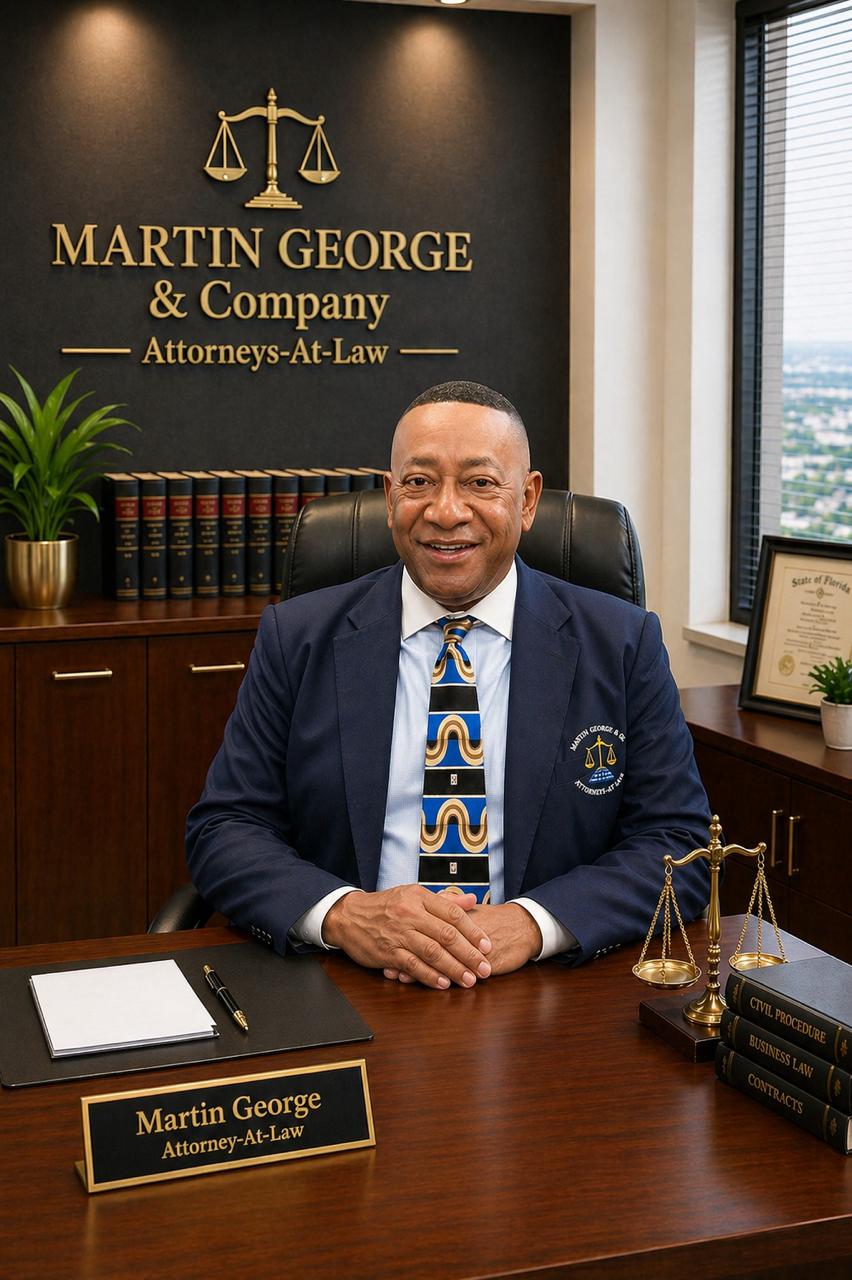
Written by Martin George, Attorney-at-Law. Martin George is the founder and principal attorney of Martin George & Company, with more than 35 years of active legal practice in the courts of Trinidad and Tobago. He is a former Commissioner on the Law Reform Commission of Trinidad and Tobago and a member of the Prime Minister's Constitutional Committee for Internal Self-Government for Tobago. This article is published for general information and public legal education. It does not constitute legal advice. For advice on your specific situation, contact Martin George & Company.
Last reviewed: April 2026